On the bus into work today my brain was going into overdrive. I know how the book is going to end and I know what's going to happen in the next one. I know where every character is going to be at the end of the final chapter and I know where they're going to go in the first of the second book.
Blimey.
Anyway, I was on Warren Ellis' website and he linked to this interview with William Gibson (http://www.theparisreview.org/interviews/6089/the-art-of-fiction-no-211-william-gibson) and I thought you might find it interesting, I did:
- - -
INTERVIEWER:
How do you begin a novel?
GIBSON:
I have to write an opening sentence. I think with one exception I've never changed an opening sentence after a book was completed.
INTERVIEWER:
You won't have planned beyond that one sentence?
GIBSON:
No. I don't begin a novel with a shopping list—the novel becomes my shopping list as I write it. It's like that joke about the violin maker who was asked how he made a violin and answered that he started with a piece of wood and removed everything that wasn't a violin. That's what I do when I'm writing a novel, except somehow I'm simultaneously generating the wood as I'm carving it.
E. M. Forster's idea has always stuck with me—that a writer who's fully in control of the characters hasn't even started to do the work. I've never had any direct fictional input, that I know of, from dreams, but when I'm working optimally I'm in the equivalent of an ongoing lucid dream. That gives me my story, but it also leaves me devoid of much theoretical or philosophical rationale for why the story winds up as it does on the page. The sort of narratives I don't trust, as a reader, smell of homework.
- - -
I think I'll respond to that thought process when I'm home, it's bloody fascinating though.
Showing posts with label Warren Ellis. Show all posts
Showing posts with label Warren Ellis. Show all posts
Thursday, 12 January 2012

Sunday, 10 July 2011
So my 200th post was a review of Warren Ellis and D'Israeli's SVK. That's alright. Milestones are something to someone and something else to anyone. Easily passed over.
I want to start writing again, but I don't know if I should start while my novel is being worked over by a friend. I have an idea for a story, straight forward detective story, no occult trappings, and I'm not sure if I should start it or not. Hmm. I'll make some notes, and see if the bug catches, but until I finish this draft of my actual novel, I'll hold.
I want to start writing again, but I don't know if I should start while my novel is being worked over by a friend. I have an idea for a story, straight forward detective story, no occult trappings, and I'm not sure if I should start it or not. Hmm. I'll make some notes, and see if the bug catches, but until I finish this draft of my actual novel, I'll hold.
Saturday, 9 July 2011
SVK
SVK is a Warren Ellis comic book. The art from Matt "D'Israeli" Brooker is crisp and clean, and the concept behind the project is smarter than anything else available right now.
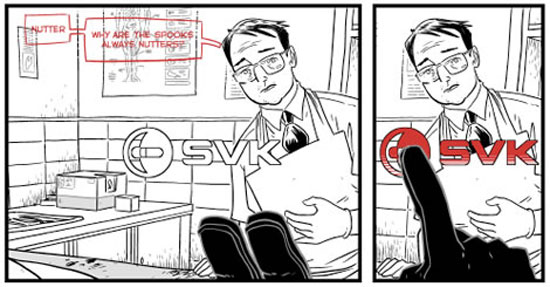
The titular "SVK", aka Special Viewing Kit, aka Strategic Vigilance Key, allows the wearer to see the thoughts of anyone around him. This is presented as thought boxes trailing from the brain and not the mouth, an extension of the classic comic book tool that has become outdated and outmoded. But instead of anyone being able to see these inner most thoughts, the reader must use their own SVK-- a ultra-violet light that when shined on the pages reveals the thought boxes that have been printed in ultra-violet ink.
Before I continue talking about SVK, a brief moment off topic. I remember a year or so back when Scott Snyder's Vertigo book American Vampire was announced, and Stephen King was involved with a back-up feature that would run through the first arc. I read an interview on The Daily Beast with King, discussing the process of writing a comic book script. King is an old school comic book fan, and his scripts were filled with thought balloons. The following is an excerpt from that interview:
Apparently, thought balloons are out of vogue with the modern comic book culture. A weird little anecdote, for sure. So SVK embraces this narrative tool wholeheartedly, giving it a modern twist that could have been kitsch and corny, but worked. Reading the thoughts of all these otherwise 2-dimensional characters moved them past what they could have simply been-- boring, staid, undeveloped personalities-- and into the realm of people with dark thoughts and hidden agendas.
Matt "D'Israeli" Brooker is a giant, his work beautiful and well thought out. He carries the weight of the story on his shoulders-- there's only so much invisible ink can do, you know?-- and it's brilliant. Chase scenes flow amazingly, you're there in the flow of it all; fight scenes are kinetic and abrupt-- as they should be. Ellis + D'Israeli (former collaborators on Ellis' 'big break', Lazarus Churchyard) need to do more together. Completely.
SVK itself is set in a Britain post-"incident". Whatever this incident is, we're not given the whole picture. Something big and loud and dangerous happened to the United Kingdom, and everyone's on edge. The main character, Woodwind, is a freelance operative, hired by people who want things doing on the hush-hush. He predicted the incident but his warnings were ignored by the higher-ups in the company he used to work for, and when finger pointing started, he was the first one thrown to the wolves. This act, obviously, made him even more of a cynical, suspicious old bastard that he originally was.
Ellis' main characters exemplify the working class hero, through his work on John Constantine when he helmed Hellblazer, to his earlier work with the creation of Peter Wisdom in Excalibur or William Gravel in the creator-owned Strange Killings series of minis and eventual Gravel ongoing. It enables him to bring his own voice to his work, and for the most part, it works.
The crux of the story is this. The SVK has been stolen, and Woodwind been hired to bring it back. So he goes about it in his own imitable way, but finds that there's more to the SVK than he was first told. It's an intriguing premise, and delivered with the usual aplomb that Ellis usually delivers. To be fair, Ellis has a penchant for going completely off the rails with his projects, his characters becoming grotesque parodies of who they could be. They usually share the same voice, the same sense of humour, and the same personality. It could be construed as a fault with Ellis' work, or identified as his voice, projected loud and clear through whatever the subject matter, but whatever it is, it's tropes like those mentioned that sometimes ruin my enjoyment of his work.
SVK is a done-in-one comic published by design company BERG, and it's a pretty package, beautifully printed and coming with an ultra-violet light. It's compact and sleek and it's everything I expected it to be.
And that's kind of the problem.
Warren Ellis follows a series of tropes in his work. The cynical, hardened "bastard" protagonist. Hard science fiction technology mixing with the real world. The cheeky sidekick. The government being absolutely corrupt. Ellis' work is a product of the era when he started writing comics, back when Thatcher was crazy and genocidal, addled in the brain but hiding it better than Regan. SVK uses every single Ellis trope around. He lifts characters from across his canon and inserts them into a new narrative. Woodwind is Gravel, the same look, the same attitude. Swap "combat magician" with "freelance science-fiction operative" and the deed is done.
The government is corrupt and overbearing, shades of Transmetropolitan bleeding through. They're removing the basic human right of not having someone read your private most thoughts and they'll do anything to get away with it, including murdering the operative hired to retrieve the item that allows you that breach of privacy! The villain of the piece, running a corporation and being devious behind everyone's back... he's The Smiler but sane. Kind of.
I wanted to love this project. I liked it. There was the classic Ellis of sheer beautiful humanity midway between Woodwind's smart arse assistant Bulmer and his mother, and the usual burst of violence that pervades his work. The end was an ambiguous one. Could I read more stories set in this universe? Yes. Was the book worth £10 (+£3 p+p)? I believe so. BERG, with SVK, have revitalised what was considered a tired old narrative tool. The thought balloon has power, when used well. With books from the Big Two (DC and Marvel) the thought balloon is used as a nostalgia tool. I remember Brian Michael Bendis' original Mighty Avengers launch, and the "uproar" when characters had minor asides inside their heads. These are the tools built by the comic book greats of the 30s, 40s, and beyond! Why should comic book writers and editors (and readers!) be ashamed of what came before?
SVK was an experiment, and a successful one at that. If I hadn't read any of Warren Ellis' work before it would have blown my mind, but I've read versions of this narrative time and time again. Would a non-fan of Ellis' work pick up this book? Probably not! If a no-name creator had written this it wouldn't have sold out in the three or four days it did. It might not have sold anything; the result could have simply been deigned an oddity of the form. But sold it did, and I'm sure it's being well received everywhere. Deservedly so? At times.
I sometimes wish I wasn't as big a fan of Ellis as I am.
You can purchase SVK here, exclusively through BERG.
The titular "SVK", aka Special Viewing Kit, aka Strategic Vigilance Key, allows the wearer to see the thoughts of anyone around him. This is presented as thought boxes trailing from the brain and not the mouth, an extension of the classic comic book tool that has become outdated and outmoded. But instead of anyone being able to see these inner most thoughts, the reader must use their own SVK-- a ultra-violet light that when shined on the pages reveals the thought boxes that have been printed in ultra-violet ink.
Before I continue talking about SVK, a brief moment off topic. I remember a year or so back when Scott Snyder's Vertigo book American Vampire was announced, and Stephen King was involved with a back-up feature that would run through the first arc. I read an interview on The Daily Beast with King, discussing the process of writing a comic book script. King is an old school comic book fan, and his scripts were filled with thought balloons. The following is an excerpt from that interview:
“I got this kind of embarrassed call from the editors saying, ‘Ah, Steve, we don't do that anymore.’ ‘You don't do that anymore?’ I said. ‘No, when the characters speak, they speak. If they're thinking, you try to put that across in the narration, in the little narration boxes.’ ... I think it's a shame to lose that arrow out of your quiver. One of the nice things about the written word as opposed to the spoken word in a movie is that you can go into a character's thoughts. You do it in books all the time, right?”
Apparently, thought balloons are out of vogue with the modern comic book culture. A weird little anecdote, for sure. So SVK embraces this narrative tool wholeheartedly, giving it a modern twist that could have been kitsch and corny, but worked. Reading the thoughts of all these otherwise 2-dimensional characters moved them past what they could have simply been-- boring, staid, undeveloped personalities-- and into the realm of people with dark thoughts and hidden agendas.
Matt "D'Israeli" Brooker is a giant, his work beautiful and well thought out. He carries the weight of the story on his shoulders-- there's only so much invisible ink can do, you know?-- and it's brilliant. Chase scenes flow amazingly, you're there in the flow of it all; fight scenes are kinetic and abrupt-- as they should be. Ellis + D'Israeli (former collaborators on Ellis' 'big break', Lazarus Churchyard) need to do more together. Completely.
SVK itself is set in a Britain post-"incident". Whatever this incident is, we're not given the whole picture. Something big and loud and dangerous happened to the United Kingdom, and everyone's on edge. The main character, Woodwind, is a freelance operative, hired by people who want things doing on the hush-hush. He predicted the incident but his warnings were ignored by the higher-ups in the company he used to work for, and when finger pointing started, he was the first one thrown to the wolves. This act, obviously, made him even more of a cynical, suspicious old bastard that he originally was.
Ellis' main characters exemplify the working class hero, through his work on John Constantine when he helmed Hellblazer, to his earlier work with the creation of Peter Wisdom in Excalibur or William Gravel in the creator-owned Strange Killings series of minis and eventual Gravel ongoing. It enables him to bring his own voice to his work, and for the most part, it works.
The crux of the story is this. The SVK has been stolen, and Woodwind been hired to bring it back. So he goes about it in his own imitable way, but finds that there's more to the SVK than he was first told. It's an intriguing premise, and delivered with the usual aplomb that Ellis usually delivers. To be fair, Ellis has a penchant for going completely off the rails with his projects, his characters becoming grotesque parodies of who they could be. They usually share the same voice, the same sense of humour, and the same personality. It could be construed as a fault with Ellis' work, or identified as his voice, projected loud and clear through whatever the subject matter, but whatever it is, it's tropes like those mentioned that sometimes ruin my enjoyment of his work.
SVK is a done-in-one comic published by design company BERG, and it's a pretty package, beautifully printed and coming with an ultra-violet light. It's compact and sleek and it's everything I expected it to be.
And that's kind of the problem.
Warren Ellis follows a series of tropes in his work. The cynical, hardened "bastard" protagonist. Hard science fiction technology mixing with the real world. The cheeky sidekick. The government being absolutely corrupt. Ellis' work is a product of the era when he started writing comics, back when Thatcher was crazy and genocidal, addled in the brain but hiding it better than Regan. SVK uses every single Ellis trope around. He lifts characters from across his canon and inserts them into a new narrative. Woodwind is Gravel, the same look, the same attitude. Swap "combat magician" with "freelance science-fiction operative" and the deed is done.
The government is corrupt and overbearing, shades of Transmetropolitan bleeding through. They're removing the basic human right of not having someone read your private most thoughts and they'll do anything to get away with it, including murdering the operative hired to retrieve the item that allows you that breach of privacy! The villain of the piece, running a corporation and being devious behind everyone's back... he's The Smiler but sane. Kind of.
I wanted to love this project. I liked it. There was the classic Ellis of sheer beautiful humanity midway between Woodwind's smart arse assistant Bulmer and his mother, and the usual burst of violence that pervades his work. The end was an ambiguous one. Could I read more stories set in this universe? Yes. Was the book worth £10 (+£3 p+p)? I believe so. BERG, with SVK, have revitalised what was considered a tired old narrative tool. The thought balloon has power, when used well. With books from the Big Two (DC and Marvel) the thought balloon is used as a nostalgia tool. I remember Brian Michael Bendis' original Mighty Avengers launch, and the "uproar" when characters had minor asides inside their heads. These are the tools built by the comic book greats of the 30s, 40s, and beyond! Why should comic book writers and editors (and readers!) be ashamed of what came before?
 | |
| I had an image from a Cho Mighty Avengers issue, but it went away. Bagley fill-in! |
SVK was an experiment, and a successful one at that. If I hadn't read any of Warren Ellis' work before it would have blown my mind, but I've read versions of this narrative time and time again. Would a non-fan of Ellis' work pick up this book? Probably not! If a no-name creator had written this it wouldn't have sold out in the three or four days it did. It might not have sold anything; the result could have simply been deigned an oddity of the form. But sold it did, and I'm sure it's being well received everywhere. Deservedly so? At times.
I sometimes wish I wasn't as big a fan of Ellis as I am.
You can purchase SVK here, exclusively through BERG.
Monday, 13 September 2010
Who Betters The Watchmen?
I've been thinking about Alan Moore a lot recently. I picked up the first issue of his new magazine "Dodgem Logic", and it was interesting, very much so, and it's help put Zenith! in position again, in my head. Underground magazine publishing, yes. But that's not what I was thinking about. I was thinking about Watchmen, his opinions on the comic book industry since Watchmen, and my own opinions on Watchmen and similar works.
There's this great interview with Alan Moore by Adi Tantimedh over at Bleeding Cool (click to read) that also played a hand in the way I'm thinking right now. Talking about how DC have offered Alan the rights to Watchmen back if he gives them permission-- perhaps a blessing?-- to work on sequels, prequels, all the terrifying marketable machine bits that would make them a whole lot of money. But the fans, as much as they love Watchmen (for some right reason and some wrong) wouldn't enjoy a Watchmen sequel. They wouldn't. If you've even got a passing knowledge of comics, you know that Watchmen is this pure thing, this nigh-untouchable project that cannot be continued, extended, whatever. I don't care about film adaptations, really. I don't think they damage the source material. So what if they changed elements? Philip Pullman once said that: "every film has to make changes to the story that the original book tells — not to change the outcome, but to make it fit the dimensions and the medium of film." and that's perfectly fine, in my opinion. You have to make the film the distilled version of the book-- how else can you get the story out in the best way?
But I digress.
History Lesson: Alan Moore assumed he'd get the rights to Watchmen back in the 80s. But DC never let it out of print, it's always been available, so that never came about. A lot of shit happened between then and now, and so we're in this weird position where Alan Moore is divorcing himself from the comic book industry and his old friends (he's fallen out with David Lloyd over the V for Vendetta adaptation, and now he's fallen out with Dave Gibbons over the Watchmen film) because of this project from the mid-eighties.
I think Alan Moore insults the industry when he makes himself out to be the pinnacle of literary artistry. I get bored of that. He was good, in his day, but what has he done that became as big as Watchmen or V for Vendetta (which I don't actually like)? Sure, his Top Ten projects have been big, but they're not on the same scale, are they?
A few quotes of interest from that interview that kind of anger me:
Because they were good? Because they stand up? Because a whole generation or two has heard of the Marvelman stories, the epic stories that Moore, Steve Bissette, Neil Gaiman and co. worked on and want to experience them for themselves? How is that unfair? Since I started reading comics, since I really got into them in my teens, I've wanted to read Marvel/Miracleman. Since I read about the legal troubles between Gaiman and Todd McFarlane I wanted to see what the fuss was about. I mean, this is important stuff. This is British comics that made a difference. And they've been locked in legal limbo for years and I want to read them. Sure, I would prefer to have the originals in my hand, but if Marvel are going to reprint the Moore/Gaiman runs, why shouldn't I leap at that chance? Stop ruining my enjoyment, Alan Moore.
This is something I intend to talk about below, but I thought I'd share it here first...
Is it wrong that I find this to be horrifically arrogant of him? Like there was a Golden Age of Comics that started and ended with Alan Moore, and no one else can compete? I've enjoyed comics since. Yes. But the thing is... when was the last time there was a comic book written that had the same literary, mainstream punch as Watchmen? Or Maus, for instance? Maus won a Pulitzer! Sin City could count, but I feel like that was more of a maxi-series, and the film was what made people pay attention.
The eighties were good, no doubt. We had so many transcendental series come out-- Moore's Swamp Thing, Neil Gaiman's The Sandman, Miller's The Dark Knight Returns as well as his Year One. Those were epic series that changed the face of the comic book industry. But when has anything changed the face of the industry since? In the 90s it was the domain of Garth Ennis, Warren Ellis and Grant Morrison, with The Preacher, Transmetropolitan and The Invisibles being the go-to for alternate comic book that shift the paradigm. In the 2000s we had Ex Machina, Y, The Last Man, Top 10 and Tom Strong, but... they don't work like I want them to work in the structure of this conversation.
But they weren't the same, I don't think. 12 issues. A maxiseries. Not a 80 issue opus... I'm talking stories that are complete in their entirety within twelve issues. That's not a thing anymore, is it? Grant Morrison came close with All-Star Superman, which I love, but I think I disqualify that in my head because it's Superman. It's not original. I want new content, I want something that makes me think and makes me fall in love with it like I did James Robinson's Starman.
It really shouldn't, no Alan.
Brian K. Vaughan has done some amazing stuff recently, the closest it comes to counting. Ex Machina was superb, a planned maxiseries that recently came to an end. Same as Y, The Last Man. Focused. Painstakingly created. Ex Machina is closer to what I'm thinking than Y, because there was one, consistent art team on that (Tony Harris, tying close to Starman with that, yes) whilst Pia Guerra traded duties with Goran Sudzuka on occasion. Garth Ennis is working with Darick Robertson on The Boys, another planned maxiseries... another finite end...
(And what is it with these specific writers working on these projects? Darick Robertson worked on Transmetropolitan, Garth Ennis on Preacher and now The Boys... Brian K. Vaughan on these maxiseries, too...)
...but do they make sense like Watchmen did, in the context of this conversation? I think Warren Ellis does the most promising work in that field, his projects, such as Ocean, Ministry of Space, Orbital, short, complete works that are beautiful and amazing. He's given us Planetary, but that has ties to the Wildstorm universe so I don't think I can count it-- even though it is the tightest of the projects to be considered. Global Frequency is the inverse of the idea, with one writer and a selection of amazing artists, twelve issues of loosely connected stories. I love that book, but it's not the same. But these titles don't reach the heights established at the heights of the eighties. They don't sell as many copies as Watchmen, they don't make the same amount of money. People aren't scrambling about to scream about them in the daily press. They should be, sure, but they should be something more. Something amazing and ascendant.
I want to see a comic, twelve issues, one complete story, like Camelot 2000, like Watchmen, something that inspires generations. Where would we be without Watchmen? I don't think the comic industry could have lasted without that shot in the arm. But at the same time, we shouldn't be dragging our heels and holding onto the past like we insist on doing. We need to prove Alan Moore wrong, because he's not what he used to be.
I think if Geoff Johns wasn't writing for DC... I don't think his work would be as good. Brian Michael Bendis does good work on Powers, and on Scarlet, but again, not the same. Mike Mignola is my hero and doing something that should become a modern folktale with Hellboy, but it's so far pushing ten trades and promising more, so it's not the 12 issue shape I was talking about. I want something to make us think, and sure, we get that with ongoings, and minis and maxis, but we need to make sure Alan Moore isn't right else we'll be stuck in this horrific rut for the rest of our lives.
There's this great interview with Alan Moore by Adi Tantimedh over at Bleeding Cool (click to read) that also played a hand in the way I'm thinking right now. Talking about how DC have offered Alan the rights to Watchmen back if he gives them permission-- perhaps a blessing?-- to work on sequels, prequels, all the terrifying marketable machine bits that would make them a whole lot of money. But the fans, as much as they love Watchmen (for some right reason and some wrong) wouldn't enjoy a Watchmen sequel. They wouldn't. If you've even got a passing knowledge of comics, you know that Watchmen is this pure thing, this nigh-untouchable project that cannot be continued, extended, whatever. I don't care about film adaptations, really. I don't think they damage the source material. So what if they changed elements? Philip Pullman once said that: "every film has to make changes to the story that the original book tells — not to change the outcome, but to make it fit the dimensions and the medium of film." and that's perfectly fine, in my opinion. You have to make the film the distilled version of the book-- how else can you get the story out in the best way?
But I digress.
History Lesson: Alan Moore assumed he'd get the rights to Watchmen back in the 80s. But DC never let it out of print, it's always been available, so that never came about. A lot of shit happened between then and now, and so we're in this weird position where Alan Moore is divorcing himself from the comic book industry and his old friends (he's fallen out with David Lloyd over the V for Vendetta adaptation, and now he's fallen out with Dave Gibbons over the Watchmen film) because of this project from the mid-eighties.
I think Alan Moore insults the industry when he makes himself out to be the pinnacle of literary artistry. I get bored of that. He was good, in his day, but what has he done that became as big as Watchmen or V for Vendetta (which I don't actually like)? Sure, his Top Ten projects have been big, but they're not on the same scale, are they?
A few quotes of interest from that interview that kind of anger me:
"I could ask about why Marvel Comics are churning out or planning to bring out my ancient MARVELMAN stories, which are even older, if they had a viable idea of their own in the quarter-century since I wrote those works."
Because they were good? Because they stand up? Because a whole generation or two has heard of the Marvelman stories, the epic stories that Moore, Steve Bissette, Neil Gaiman and co. worked on and want to experience them for themselves? How is that unfair? Since I started reading comics, since I really got into them in my teens, I've wanted to read Marvel/Miracleman. Since I read about the legal troubles between Gaiman and Todd McFarlane I wanted to see what the fuss was about. I mean, this is important stuff. This is British comics that made a difference. And they've been locked in legal limbo for years and I want to read them. Sure, I would prefer to have the originals in my hand, but if Marvel are going to reprint the Moore/Gaiman runs, why shouldn't I leap at that chance? Stop ruining my enjoyment, Alan Moore.
"Just simply get some of your top-flight talent to put out a book that the wider public outside of the comics field find as interesting or as appealing as the stuff that I wrote 25 years ago. It shouldn’t be too big an ask, should it?"
This is something I intend to talk about below, but I thought I'd share it here first...
"They must have one creator, surely, in the entire American industry that could do equivalent work to something I did 25 years ago. "
Is it wrong that I find this to be horrifically arrogant of him? Like there was a Golden Age of Comics that started and ended with Alan Moore, and no one else can compete? I've enjoyed comics since. Yes. But the thing is... when was the last time there was a comic book written that had the same literary, mainstream punch as Watchmen? Or Maus, for instance? Maus won a Pulitzer! Sin City could count, but I feel like that was more of a maxi-series, and the film was what made people pay attention.
The eighties were good, no doubt. We had so many transcendental series come out-- Moore's Swamp Thing, Neil Gaiman's The Sandman, Miller's The Dark Knight Returns as well as his Year One. Those were epic series that changed the face of the comic book industry. But when has anything changed the face of the industry since? In the 90s it was the domain of Garth Ennis, Warren Ellis and Grant Morrison, with The Preacher, Transmetropolitan and The Invisibles being the go-to for alternate comic book that shift the paradigm. In the 2000s we had Ex Machina, Y, The Last Man, Top 10 and Tom Strong, but... they don't work like I want them to work in the structure of this conversation.
But they weren't the same, I don't think. 12 issues. A maxiseries. Not a 80 issue opus... I'm talking stories that are complete in their entirety within twelve issues. That's not a thing anymore, is it? Grant Morrison came close with All-Star Superman, which I love, but I think I disqualify that in my head because it's Superman. It's not original. I want new content, I want something that makes me think and makes me fall in love with it like I did James Robinson's Starman.
"Just simply get some of your top-flight talent to put out a book that the wider public outside of the comics field find as interesting or as appealing as the stuff that I wrote 25 years ago. It shouldn’t be too big an ask, should it?"
It really shouldn't, no Alan.
Brian K. Vaughan has done some amazing stuff recently, the closest it comes to counting. Ex Machina was superb, a planned maxiseries that recently came to an end. Same as Y, The Last Man. Focused. Painstakingly created. Ex Machina is closer to what I'm thinking than Y, because there was one, consistent art team on that (Tony Harris, tying close to Starman with that, yes) whilst Pia Guerra traded duties with Goran Sudzuka on occasion. Garth Ennis is working with Darick Robertson on The Boys, another planned maxiseries... another finite end...
(And what is it with these specific writers working on these projects? Darick Robertson worked on Transmetropolitan, Garth Ennis on Preacher and now The Boys... Brian K. Vaughan on these maxiseries, too...)
...but do they make sense like Watchmen did, in the context of this conversation? I think Warren Ellis does the most promising work in that field, his projects, such as Ocean, Ministry of Space, Orbital, short, complete works that are beautiful and amazing. He's given us Planetary, but that has ties to the Wildstorm universe so I don't think I can count it-- even though it is the tightest of the projects to be considered. Global Frequency is the inverse of the idea, with one writer and a selection of amazing artists, twelve issues of loosely connected stories. I love that book, but it's not the same. But these titles don't reach the heights established at the heights of the eighties. They don't sell as many copies as Watchmen, they don't make the same amount of money. People aren't scrambling about to scream about them in the daily press. They should be, sure, but they should be something more. Something amazing and ascendant.
I want to see a comic, twelve issues, one complete story, like Camelot 2000, like Watchmen, something that inspires generations. Where would we be without Watchmen? I don't think the comic industry could have lasted without that shot in the arm. But at the same time, we shouldn't be dragging our heels and holding onto the past like we insist on doing. We need to prove Alan Moore wrong, because he's not what he used to be.
I think if Geoff Johns wasn't writing for DC... I don't think his work would be as good. Brian Michael Bendis does good work on Powers, and on Scarlet, but again, not the same. Mike Mignola is my hero and doing something that should become a modern folktale with Hellboy, but it's so far pushing ten trades and promising more, so it's not the 12 issue shape I was talking about. I want something to make us think, and sure, we get that with ongoings, and minis and maxis, but we need to make sure Alan Moore isn't right else we'll be stuck in this horrific rut for the rest of our lives.
Wednesday, 28 April 2010
"The Chain" - INSPIRATION!
I'm trying to figure out what goes into my novel writing process. It's mostly music and comics, intravenously pushed into my system by amps and my eyes, and then condensed into whatever the heck my novel turns out to be like.
I have no faith in the final product.
But why should I stop? I've been at this for nearly a year now, and to stop now it just ridiculous. Sure, the plot keeps getting twistier and more insane, but fucking come on, 'The DaVinci Code'?. I think I can provide something much more less shit than that, right?
...Right?
So anyway. Music. A lot of it. Nine Inch Nails to Led Zeppelin to Tiger Lou. Not any one genre, mind. Not all of it with lyrics. Some of it could be classed as noise-- I mean, Clint Mansell's instrumental scores are immense, same as Charlie Clouser's. And God knows I love me some Combichrist (though I'll admit, a lot of their instrumental stuff-- noise-- does sound so similar... I just don't care), and Nine Inch Nails are my bread and butter-- but check out Ghosts I-IV... not what you would expect from the guy who won a Grammy with the lyric "...gotta listen to your big time hard line bad luck fist fuck...", right?
(Obviously the 'Grammy committee' weren't all "Oh, 'fist fuck'! What the music industry has been missing!", but come on. Bear with me.)
So a lot of it is music. Inspiration. Good stuff.
And a lot of it is information. Stuff I've read and I've heard or I've seen. Characters are people I know, mixed and matched and smudged together so you wouldn't recognise them. My main character is someone I saw in a low budget horror film*. I saw him, half way through writing the novel, and I was like "Holy shit, what's he doing there?" because that was my guy. That was Taylor Mahn, all flesh and blood and broken pieces of spirit, that was him right there. How am I supposed to take that?
(I took it well)
(*'Masters of Horror: Dear Woman', by the by. Damn you John Landis, you ruin me! In an alternate reality Brian Benben would play the lead role in the film adaptation of my novel.)
And then the literary references. Come on. Warren Ellis, Neil Gaiman, James Robinson. I owe my style to them. Heck, one's a comic book writer (they're all comic book writers, but Ellis and Gaiman have at least had novels published!) but that doesn't stop him being an inspiration (some time soon I might take a break from the self deprecation and post up a list of Must Read comics, but until then...). HP Lovecraft, even though I'm not as knowledgeable about his work as I should be (I'm more knowledgeable about the man), is a big influence, as anything with gods and monsters should be. I mean, come on:
(That translates to "In his house at R'lyeh, dead Cthulhu waits dreaming." for those of you interested)
And then comes the television stuff. Oh, God. This is the worst. Supernatural, for instance, is not as big an influence as it looks like it should be. I started writing this before some of the major plot stuff started moving in Season Four, and I was reaaally pissed when things started coinciding. I don't want this to be fan fiction because that would just hurt, but it might appear to be, right? Not that Sam and Dean and Castiel (with a little help from Bobby) are running around trying to stop the apocalypse, right? But still, some of the characters are present (Lucifer, for one. Duh) that can cause people to point at me and say I'm a hack.
I don't want that!
(Really.)
But anyway, I'm posting this because I'm winding down from some hardcore novel writing tonight. Things are coming together. I'm prowling around the hardest scenes to write, so obviously I'm procrastinating. But soon I'll be done. I think I'll hit a year.
I have no faith in the final product.
But why should I stop? I've been at this for nearly a year now, and to stop now it just ridiculous. Sure, the plot keeps getting twistier and more insane, but fucking come on, 'The DaVinci Code'?. I think I can provide something much more less shit than that, right?
...Right?
So anyway. Music. A lot of it. Nine Inch Nails to Led Zeppelin to Tiger Lou. Not any one genre, mind. Not all of it with lyrics. Some of it could be classed as noise-- I mean, Clint Mansell's instrumental scores are immense, same as Charlie Clouser's. And God knows I love me some Combichrist (though I'll admit, a lot of their instrumental stuff-- noise-- does sound so similar... I just don't care), and Nine Inch Nails are my bread and butter-- but check out Ghosts I-IV... not what you would expect from the guy who won a Grammy with the lyric "...gotta listen to your big time hard line bad luck fist fuck...", right?
(Obviously the 'Grammy committee' weren't all "Oh, 'fist fuck'! What the music industry has been missing!", but come on. Bear with me.)
So a lot of it is music. Inspiration. Good stuff.
And a lot of it is information. Stuff I've read and I've heard or I've seen. Characters are people I know, mixed and matched and smudged together so you wouldn't recognise them. My main character is someone I saw in a low budget horror film*. I saw him, half way through writing the novel, and I was like "Holy shit, what's he doing there?" because that was my guy. That was Taylor Mahn, all flesh and blood and broken pieces of spirit, that was him right there. How am I supposed to take that?
(I took it well)
(*'Masters of Horror: Dear Woman', by the by. Damn you John Landis, you ruin me! In an alternate reality Brian Benben would play the lead role in the film adaptation of my novel.)
And then the literary references. Come on. Warren Ellis, Neil Gaiman, James Robinson. I owe my style to them. Heck, one's a comic book writer (they're all comic book writers, but Ellis and Gaiman have at least had novels published!) but that doesn't stop him being an inspiration (some time soon I might take a break from the self deprecation and post up a list of Must Read comics, but until then...). HP Lovecraft, even though I'm not as knowledgeable about his work as I should be (I'm more knowledgeable about the man), is a big influence, as anything with gods and monsters should be. I mean, come on:
"Ph'nglui mglw'nafh Cthulhu R'lyeh wgah'nagl fhtagn."
(That translates to "In his house at R'lyeh, dead Cthulhu waits dreaming." for those of you interested)
And then comes the television stuff. Oh, God. This is the worst. Supernatural, for instance, is not as big an influence as it looks like it should be. I started writing this before some of the major plot stuff started moving in Season Four, and I was reaaally pissed when things started coinciding. I don't want this to be fan fiction because that would just hurt, but it might appear to be, right? Not that Sam and Dean and Castiel (with a little help from Bobby) are running around trying to stop the apocalypse, right? But still, some of the characters are present (Lucifer, for one. Duh) that can cause people to point at me and say I'm a hack.
I don't want that!
(Really.)
But anyway, I'm posting this because I'm winding down from some hardcore novel writing tonight. Things are coming together. I'm prowling around the hardest scenes to write, so obviously I'm procrastinating. But soon I'll be done. I think I'll hit a year.
Tuesday, 16 March 2010
Thinking About Zenith! Magazine
It's very hard to create something. Characters, properties, ideas that you can sell on to the highest bidder... it's very difficult. So when wanting to create a magazine, a sort of catchment for all the brilliance that you experience from your friends on a daily basis, that should be the hardest thing of them all. It's not yours, not completely. You're at the mercy of people. Deadlines. Busy schedules. Writer's Block (not that it truly exists).
People make promises that they don't deliver on. Some people deliver on their promises beyond what you were originally expecting, and that's a wonderful experience, I've discovered. It happens around the beginning of the scouring period for content:
"I'll try and get something to you, but I don't know what." "Awesome, whatever you do, I look forward to it." An hour before the deadline: "Check your inbox." After checking said inbox and opening an elaborately titled file: "Wow."
That's the moment I live for now, when I'm in my Zenith! headspace. Sure, I'd like that moment to come regularly, and I'd love for it to come maybe, I don't know, a month before the deadline, but it's that punch-the-air-in-gratitude moment that is currently the connective membrane of what I'm living.
I want this to succeed. Truly. Issues might be late. That's the way of the world. Heck, I live a life too, and it doesn't always revolve around Zenith!. I want to create characters, properties, ideas that can sustain me. I want to finish my novel. I want to be able to show off about things. But Zenith!... Right now, Zenith! is what I want to show off about. I want to see it made real. I want to hold it in my hands. I want you all to be able to hold it in your hands. So, of course, when it's ready for ordering you'll know it. I won't shut up about it. This is off our own backs. Other people have sponsorship. Advertisements fill their pages. I can't help but feel that things like that might compromise their content. That it can't help, even if it's not the case, feel as if all the stuff inside is mandated. I've collected free, ad-driven magazines (heck, I've paid for some of them) from across the country. Wherever I've gone and whenever I find them, I pick them up and I read them. And I'm always left wanting more from it. Not that it inspires wanting through content, but because it's so lacking.
So, right, Zenith!. Zenith! is full of stuff. Zenith! isn't a niche magazine because, right now, we're finding out legs, building our foundation. We're looking for anything to fill its pages. And #1 is being built. Constructed. Developed. And soon, we'll have something to show for it. Something that's made from sweat and tears and blood and wanting. That's what this is all about.
The end game. The end product. Are you as excited as me?
On a different note, Warren Ellis said this on Writer's Block. And I can't help but feel it's true, even if I do sometimes say I'm struggling. But that's the thing, I struggle, and I write, and I write shit sometimes but I don't suddenly find myself without abiltiy to put word onto paper or finger to key. Anyway, I'll let him do the talking. It's easier that way: "Writer’s block? I’ve heard of this. This is when a writer cannot write? Then that person isn’t a writer anymore. The job is getting up in the morning and fucking writing. If you get up in the morning and you cannot write, you’re something else, aren’t you?"
Sunday, 27 September 2009
SUPER-SANITY--! #4
I'm going to take a break from the norm and just highlight some links and articles of interest from the past few months that I liked. I'm not feeling particularly super, nor am I feeling very sane, so this will have to do for now...
1) This is an interview done by my dear friend Brian Burchette, talking to Marian Churchland about her first graphic novel "Beast!", and what follows is a short excerpt:
Now I've read the After-word to the book, so I've gotten some of the history of the creation of this title, but let me ask you: How long was the character of Beast actually floating in your mind before you were able to put him on paper?
It's hard to pin-down, because so many of my stories (or initial ideas for stories) have a character that resembles Beast. I think that his specific design, though - the shadowy tendril thing - first showed up in a story I fiddled with briefly a couple years before I began the book, about a girl in medieval Ireland searching for her missing brother in a ruined castle. Sort of a ye-olde Resident Evil, in which the lord of the castle was an oddly polite gentleman-monster. The story never worked out, but the monster stuck around.
2) I'm a big fan of Grant Morrison, and this interview from The Onion's A.V. Club, is really cool and insightful. Morrison is one of the greatest [comic] writers of this generation, up with Stan Lee, Roy Thomas, Julius Schwartz, Neil Gaiman, etc and etc.
GM: Secretly, I’ve always felt I had more in common with the modernist approach than with postmodernism, but I can see where the connection might arise—and to be honest, I’m no academic, so I tend to use these words, like in Alice In Wonderland, to mean what I want them to mean rather than what they actually do mean. I could point to “classical” influences on the style of All-Star Superman, or a “romantic” approach to Batman, but I’m sure any competent English lit professor could shoot me down in flames in an instant. I just do what I do because it feels right. Other people attach labels to that. I aspire in my work to the kind of luminous, “authorless” poetic transparency found in Alan Garner’s brilliant novels Thursbitch and Strandloper, but I’m far from reaching that goal.
3) This is one of the greatest pitches that has never seen publication. There have been many pieces of comic book brilliancy that have been written, pencilled, printed, and then pulped because of questionable content. Swamp Thing meeting Jesus? Written, I believe pencilled, and then scrapped at the last moment because people would get all uproarious. Warren Ellis' greatest issue of Hellblazer was drawn by Phil Jimenez, called "Shoot", and never put on sale. I've read it on the internet, I have it on my laptop, and I treasure the greatness of it. I'll post it up one of these days, but for now, this pitch is one of the greatest untold stories of the DC universe. Written by Alan Moore-- and if you don't know him now, then you can drop off the map of popular culture-- and influencing a legion of writers since, Twilight of the Gods is simply amazing.
...The body of Congo Bill, now over ninety years old, refuses to die. The gorilla mind that has been trapped in it unfairly refuses to let go and is hanging on with a fierce and horrible willpower. Unable to bring himself to kill it outright, Congorilla keeps the shackled and naked old man in special rooms at his apartment, feeds it garbage and hopes it will die soon, but it doesn't. It just lies in the corner and snarls weakly when he enters and fixes him with its ancient glaring eyes as he gives it its food.
4) And finally, this site is the one I turn to whenever I want to find out about the latest in horror. It's amazing, concise, and you should always have a resource when you want some weird shit funnelling into your brain. Oh, and also 5) Warren Ellis' blog, which, heh, is concentrated weird shit being funnelled into a brain.
Monday, 29 June 2009
Bad-luck wind been blowing on my back...
"Back in my hotel room to write this talk, and I put Glastonbury up on the tv while I write. Springsteen's on. Not a huge fan of the man, though I admire his industry. The man puts in a day's work on stage. And he's sweating, working hard. Got his foot up on an amp as he sings. It's just him, right now, the stage is blacked out, and there's one spot behind him. And he's hot, and it's cold night out there, and he's steaming. And he's just blown the authenticity thing and gone into supermystification, because it looks like he's got an electromagnetic halo, curls of glowing, pearly white light rising up from and playing around his head and shoulders while he stands there in near-silhouette....
He looks like he's The Last Rock Star, the Ascended Master who glows in the dark."
-- Warren Ellis on Bruce Springsteen's Glastonbury 2009 performance.
He looks like he's The Last Rock Star, the Ascended Master who glows in the dark."
Wednesday, 18 February 2009
I want something good to die for, to make it beautiful to live...
"Relax. These are the quiet times, where you get to think, to take the world in, and to decide who you want to be. And these times will never come again. They're as crucial to your life as the experience of being partnered that you want. Use these days. And, I tell you - just when you think you've about got things sorted out in your head..."
--Warren Ellis on relationships ending
--Warren Ellis on relationships ending
Subscribe to:
Posts (Atom)